Does More Protein Mean Better Dog Food?
When you’re comparing two bags of dog food, it’s tempting to look at the numbers.
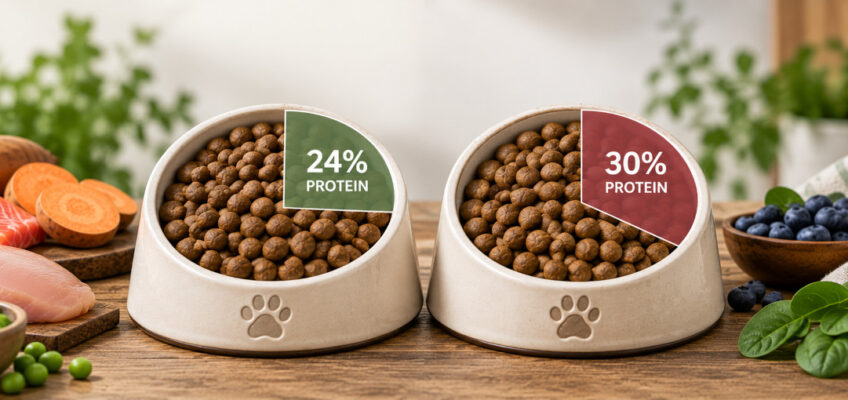
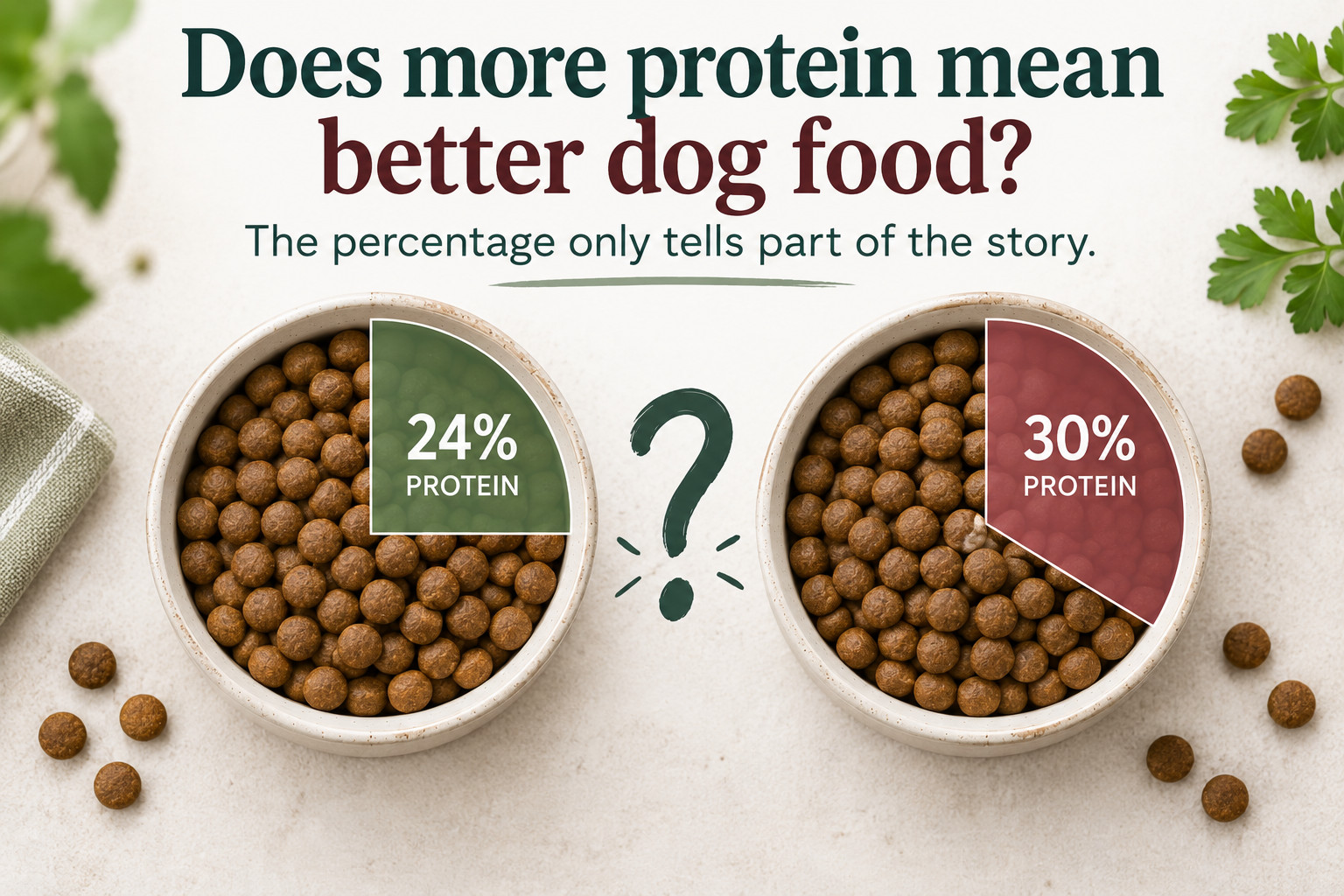
One contains 24% protein.
Another contains 30% protein.
So the second one must be better… right?
Not necessarily.
Protein is an essential part of your dog’s diet, but the percentage printed on the label only tells you part of the story.
Where that protein comes from, the amino acids it provides, how digestible it is and how the ingredients have been processed can all matter too.
So, in this Broadleaf Dog Guide, we’re taking a closer look at protein — and why more doesn’t automatically mean better.
Why Do Dogs Need Protein?
Protein performs a wide range of important functions throughout your dog’s body.
It’s needed to help build and maintain tissues and provides amino acids that the body uses for many different processes.
You can think of amino acids as the building blocks of protein.
Some amino acids can be produced by a dog’s body, while others need to come from their diet.
These are known as essential amino acids.
That’s why assessing protein isn’t simply about asking:
“How much protein is there?”
We also need to think about the nutritional quality of the protein providing it.
FEDIAF’s nutritional guidance, for example, doesn’t simply specify protein requirements; it also sets requirements for individual essential amino acids.
What Does the Protein Percentage on Dog Food Actually Mean?
Turn over a bag of dog food and look for the Analytical Constituents.
You’ll usually see something like:
Crude Protein: 26%
As we explained in our previous guide to reading dog food labels, this figure tells you the measured protein content of the food.
That’s useful.
But it doesn’t tell you where all that protein came from.
To understand that, you need to look at the Composition as well.
For example, protein in a recipe can come from animal ingredients such as chicken, beef, turkey or fish, while ingredients from plant sources can contribute protein too.
So two foods displaying exactly the same crude protein percentage don’t necessarily contain the same ingredients or provide their protein in exactly the same way.
The number gives you the quantity. The ingredients help give you the context.
Protein Percentage and Protein Quality Aren’t the Same Thing
This is probably the most important point.
Imagine two foods both contain 28% crude protein.
Looking at that number alone, they appear identical.
But one number can’t tell you everything about the sources of that protein, its amino-acid profile or how readily the dog’s digestive system can break it down.
That’s why choosing a dog food purely because it displays a higher protein percentage can be misleading.
A better approach is to consider the protein figure alongside the composition of the food.
Ask yourself:
Which ingredients are providing the protein?
Are the animal protein sources clearly identified?
How has the food been prepared?
Suddenly, that percentage has much more meaning.
What Does Protein Digestibility Mean?
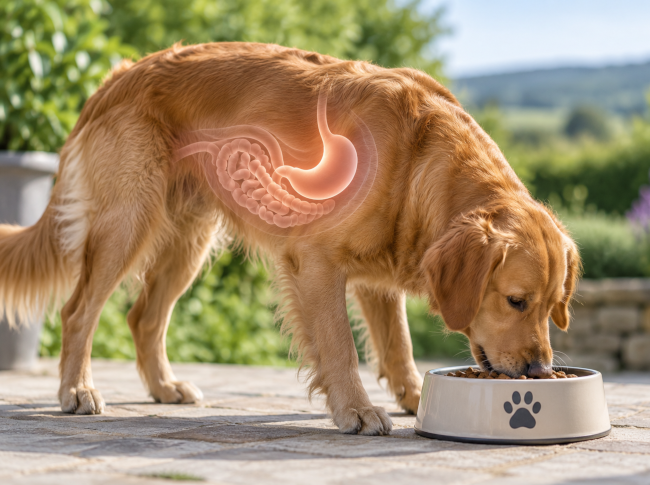
There’s another piece of the puzzle: digestibility.
Before your dog’s body can make use of the nutrients contained in food, digestion needs to break that food down.
In simple terms, protein digestibility describes how effectively protein can be broken down and made available for the body to use.
And this is one reason why simply choosing the food with the largest protein number doesn’t necessarily tell you which food will provide the most useful nutrition.
The source and processing of protein can influence its digestibility.
Research cited in GA Pet Food Partners’ scientific work on Freshtrusion®, for example, shows that thermal processing can alter the digestibility and bioavailability of meat proteins.
So how protein reaches the bowl matters as well as how much is there.
Does the Way Protein Is Cooked Matter?
It can.
Cooking is, of course, an important part of producing dry dog food, but different processing conditions can affect proteins differently.
Research reviewed by GA explains that lower-temperature cooking can cause structural changes in meat proteins that expose more sites to digestive enzymes, potentially helping those enzymes break the protein down.
Conversely, intense high-temperature cooking can promote oxidation, cross-linking and aggregation of proteins, which can make them more difficult for digestive enzymes to break down.
This is one of the principles behind the Freshtrusion® process used to produce Broadleaf Grain Free.
Fresh meat and fish ingredients arrive chilled before preparation in GA Pet Food Partners’ Meat Kitchen. Freshtrusion® uses a gentle cooking process designed to protect protein quality before the freshly prepared ingredients become part of the finished kibble.
We’ve explored that process in more detail in our previous guide:
Your Dog’s Food Starts Fresh. But What Happens Next?
Animal Protein or Plant Protein?
This is where we need to avoid another common oversimplification.
It wouldn’t be accurate to say:
Animal protein = good. Plant protein = bad.
Different ingredients provide different combinations and amounts of amino acids, and a properly formulated complete dog food needs to meet the dog’s overall nutritional requirements.
Plant ingredients can therefore contribute useful protein and nutrients within a balanced recipe.
What matters is the overall formulation of the food and whether it supplies the nutrients and essential amino acids your dog needs.
So rather than searching a label for one supposedly perfect ingredient, look at the recipe as a whole.
What About Very High-Protein Dog Foods?
A higher-protein food isn’t automatically better simply because the number is bigger.
Different dogs can also have different nutritional requirements according to factors such as their age, life stage, activity and health.
FEDIAF notes, for example, that protein provision in older dogs should help minimise loss of lean body mass and provide sufficient essential amino acids; where food intake falls, a higher protein concentration may help meet their requirements. Certain diseases, however, can require adjustments to protein provision.
That illustrates why there’s no single protein percentage that automatically makes one food the right choice for every dog.
If your dog has a medical condition or specific dietary requirement, your vet should help you determine the most appropriate diet.
So, How Should You Compare Protein in Dog Foods?
Next time you’re comparing two bags, don’t stop at:
Food A: 24% protein
Food B: 30% protein
Instead, look at the protein percentage and then turn to the Composition.
Consider:
- where the protein comes from
- whether the animal protein sources are clearly identified
- the overall meat and fish content
- how the ingredients have been prepared
- whether the food is complete and suitable for your dog’s life stage
You’re no longer comparing two numbers.
You’re comparing two foods.
The Number Matters. But So Does the Story Behind It.
Protein percentage is useful information.
It’s just not the whole story.
A higher number on the packet doesn’t automatically tell you that a food contains better-quality protein — or that it’s a better choice for your particular dog.
At Broadleaf Grain Free, we believe in looking beyond the headline percentage.
We focus on clearly identified meat and fish ingredients, carefully considered recipes and the way those ingredients are prepared through Freshtrusion®.
Because when it comes to your dog’s food, the question isn’t simply:
“How much protein does it contain?”
It’s also:
“Where does that protein come from — and what happens to it before it reaches the bowl?”